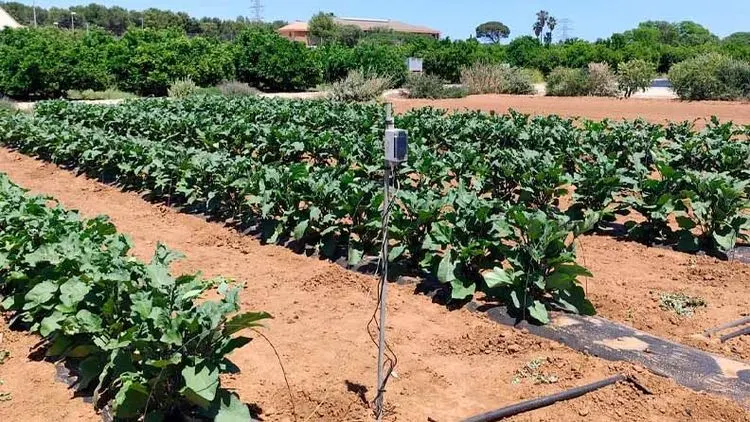
Irrigation efficiency (2023–2025). Trials in years with severe water deficit highlight the importance of achieving more kilograms per litre of water.
BrioAgro's climate adaptation outperforms standard methods thanks to its real-time response, with success stories in pepper, watermelon and aubergine.
This November, Fundación Cajamar's Plataforma Tierra published the results of a trial, conducted from 1 April to 1 September 2025, featuring a triple irrigation comparison, evaluated according to three methodologies:
- FAO system recommendations (Food and Agriculture Organization of the United Nations) based on reference evapotranspiration (ET₀) and crop coefficients (Kc), widely used by agronomists worldwide, as it is the methodology taught in universities and technical centres.
- Agronomic Criteria, based on the FAO System, applied by expert technicians with extensive irrigation experience, adapted to their knowledge of the crop and the climatic conditions of each area.
- BrioAgro's smart irrigation system, consisting of a soil moisture sensor and an actuator that manages irrigation based on information received in real time (costing from €140 per month).
This same methodology, used at the Fundación Cajamar Experimental Farm in Paiporta (Valencia), was already applied in previous seasons with other crops. In total, three trials have been carried out over the last three years:
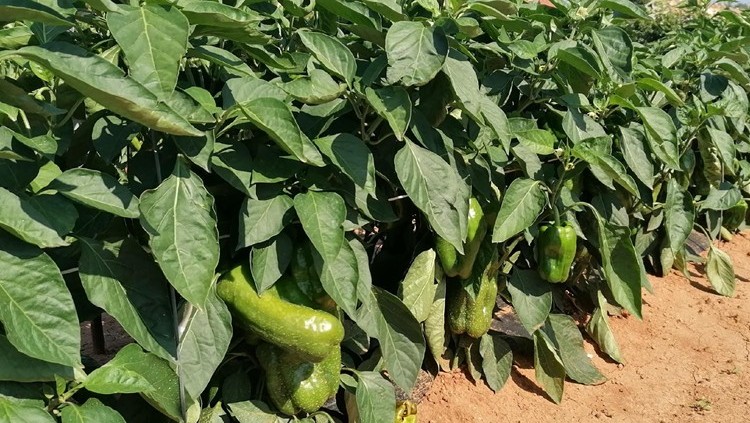
- Pepper – Pompeo variety (Nuhmens). Planting: 09/03/2023. Harvesting: from 16/06/2023 to 21/09/2023.
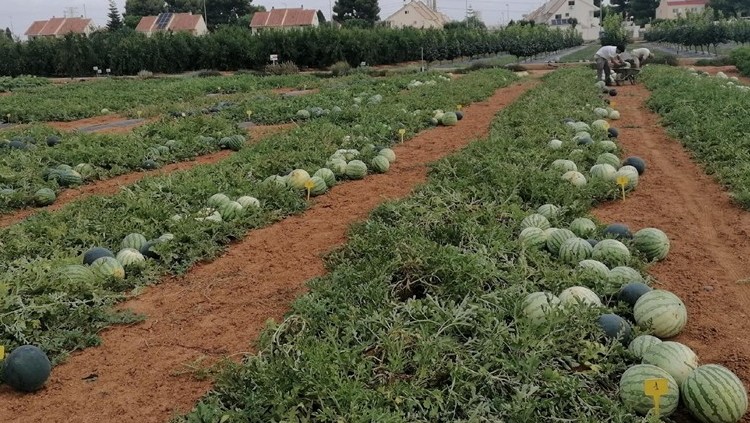
- Watermelon – Boston (Nuhmens) and Azabache (Intersemillas) varieties. Planting: 05/04/2023. Harvesting: 17/07/2023.
- Aubergine – Cristal variety (Fitó). Planting: 02/04/2025. Harvesting: 25/08/2025.
The analysed trials show that the BrioAgro system not only increases production,
but also professionalises irrigation management through precise tools and real-time data,
providing clear competitive advantages for the modern farmer.
This table summarises the most notable results.
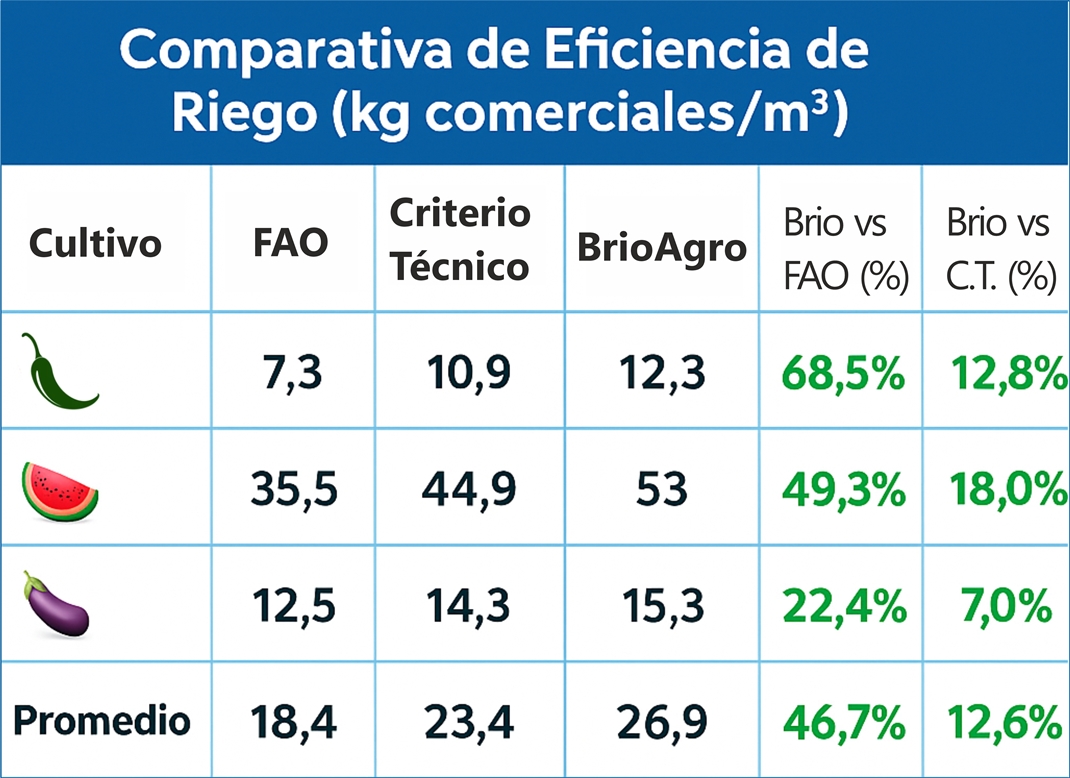
This shows that the BrioAgro system helps improve profitability without the need to expand the cultivated area. It is adaptable to different crops and production systems.
From a scientific point of view, the watermelon results were worthy of a ”PAPER” publication in the SECH – Spanish Society for Horticultural Sciences – sech.info
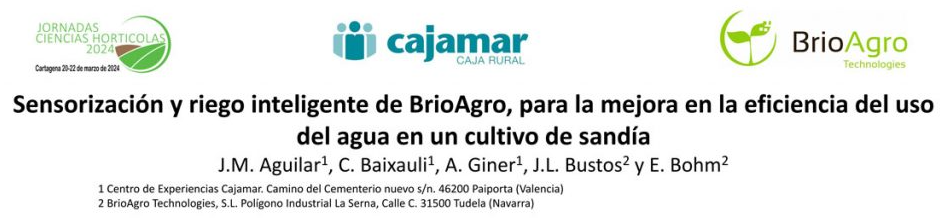
We also want to highlight the production data.
In the case of watermelon, in 2023, they were 12.3% higher than those obtained with the technical criteria of an agronomic expert, as BrioAgro achieved 9.8 t/ha more commercial production.
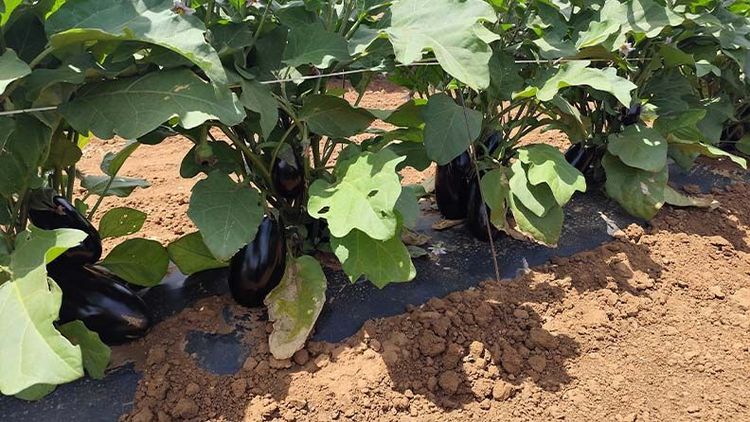
In the case of aubergine, in 2025, with very different conditions, the increase was 8.7%, which in absolute terms means 7.8 t/ha more commercial production.
Climatic analysis of the growing period
Period: from 1 April – 1 September, years 23, 24 and 25)
The analysis of the climatic conditions over the last three years shows significant differences in the atmospheric factors that directly influence the yield and water requirements of horticultural crops.
Although the rainfall recorded at the beginning of 2025 may create the perception that irrigation demand would be lower, in irrigated horticultural crops this interpretation is incorrect. The exceptional rain that fell in March mainly contributed to recharging the aquifers and increasing moisture in deep horizons. However, when the crop started in April, that moisture was barely available in the top 30 cm of the soil, which are key for root absorption in short-cycle horticultural crops.
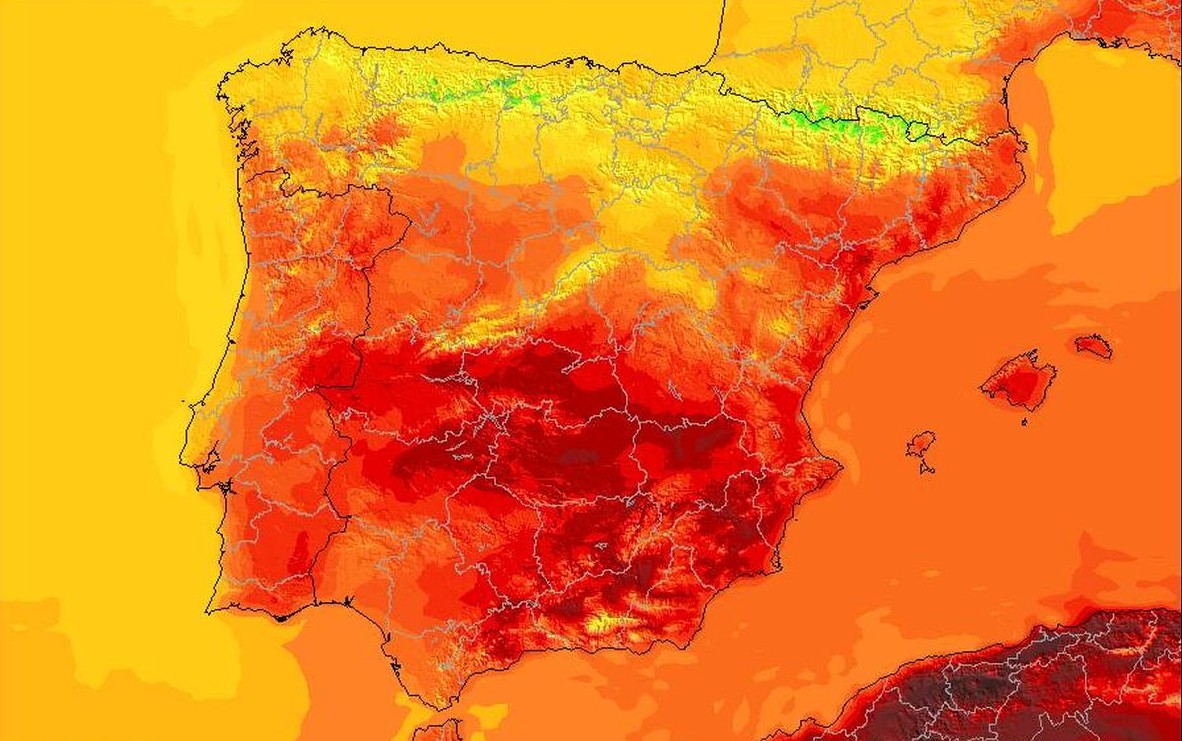
Environmental water deficit: evolution and comparison
The most notable aspect of the meteorological analysis is the very sharp increase in the environmental water deficit in 2025 compared to 2024 and, especially, compared to 2023. This increase reveals a significantly drier environment with a higher thermal load, which translates into a higher evaporative demand and greater atmospheric stress for the crop.
The predominant ranges of water deficit (grams of H₂O per kilogram of air) were:
- 2023: 3–8 g/kg
- 2024: 8–12 g/kg
- 2025: 10–18 g/kg
This means that in 2025, systematically higher levels of atmospheric dryness were recorded, with maximum and average values well above previous years.
In comparative terms, the average water deficit in 2025 is approximately 155% higher than in 2023, which shows a substantial change in evaporative conditions in the field.
Adaptation to climatic reality
The results obtained in 2025 are particularly noteworthy from the producer's point of view: 9% more production was achieved compared to the technical criteria, increasing water consumption by only 2%. And, as is usual with BrioAgro, a higher water yield was achieved, i.e., more kilograms of commercial production per litre of water applied, which in the case of aubergine meant 7% more.
However, if we analyse these results from the perspective of adaptation to climatic conditions, we observe that 2025 was a year marked by an exceptionally high environmental water deficit. Let us remember that this indicator reflects the atmospheric state in which the crop develops (grams of water per kilogram of air). This value, obtained from the geolocated weather stations that BrioAgro provides free of charge to its clients, turned out to be 155% higher than that recorded in 2023, showing conditions of extreme dryness and higher thermal load.
In this trial, the BrioAgro system managed irrigation automatically following pre-established guidelines at the start of the crop. Although these guidelines could be adjusted, only two modifications were made:
- A more conservative adjustment in spring, with slightly lower thresholds.
- An upward adjustment in late spring and summer, to anticipate the sharp increase in water deficit.
With this approach, the system activated irrigation when soil moisture dropped below the set threshold to prevent the crop from approaching water stress situations.
The combination of the information provided by BrioAgro ViTA and the actuation capacity of the Aqua Power system allowed for highly adaptive irrigation management (smart irrigation):
- On days with a mild water deficit, irrigation was spaced further apart.
- In periods of severe deficit, irrigation occurred up to three times in the same day, without excesses in the irrigation pulses that could cause percolation or deficits that would lead to stress.
This level of real-time adaptation has proven to be clearly advantageous compared to models based solely on evapotranspiration, which are very useful but less reactive to sudden changes in atmospheric conditions.
Furthermore, it is worth noting a common situation in both this trial and others: when rain is forecast, some technicians and farmers, and their models, stop irrigation preventively. However, frequently the actual precipitation does not provide the equivalent of effective irrigation, generating water stress which, in this case, was observed in late July and early August in sectors not managed by BrioAgro. In contrast, the sector controlled by BrioAgro did not suffer this stress, as the system autonomously adjusted the irrigation frequency according to the actual moisture of the root bulb, making it possible to maintain water stability throughout the cycle.
The increase in yield per hectare generates a direct economic benefit for the farmer, especially in high-value horticultural crops. In addition, greater water efficiency helps to reduce operating costs.
Links of interest related to this publication:
17/11/2025. BrioAgro achieves higher aubergine production in a comparison of three irrigation methods
10/11/2025. Aubergine results on Plataforma Tierra:
27/05/2024. El agroautentico.com echoing the results:
BrioAgro trials its smart irrigation on watermelon and pepper: savings and more kilos per cubic metre (in Spanish)
29/04/2024. Watermelon and Pepper results on Plataforma Tierra: