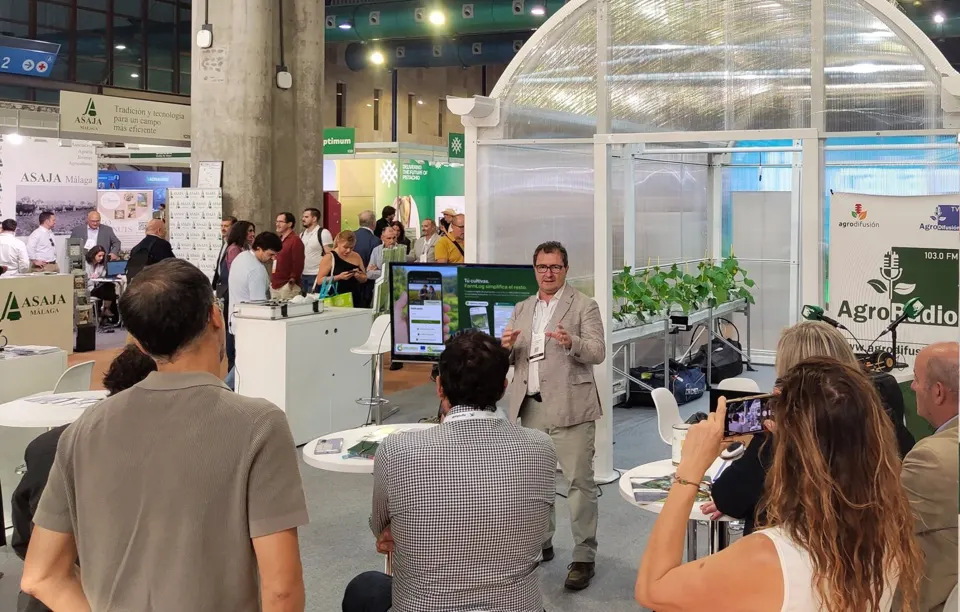
The record of plant protection treatments will be digital from 1 January 2027, and BrioAgro's digital farm logbook (CUE) Farmlog solves this via WhatsApp: the farmer reports what they have done with a message, an audio or a photo, and the agronomist validates it from a free panel. BrioAgro presented it to crop agronomists, advisers and researchers at Expo AgriTech (Malaga, 4 and 5 November).
Published in HortiDaily. This news was published on Tuesday 10 November 2026 on HortiDaily.es (in Spanish) and in its newsletter (in Spanish), which is received by more than 56,600 registered subscribers in the agricultural sector. Here we expand on it with more detail, additional images and FAQs.
Keys to the CUE Farmlog in 30 seconds
- Key date: from 1 January 2027, the record of professional use plant protection treatments must be electronic.
- For the farmer: record via WhatsApp with a message, an audio or a photo, without learning another application.
- For the agronomist: free panel with all their farms, the campaign for each one, their documentation and what is pending.
- Delivery notes: a photo is enough for Farmlog to extract products and quantities.
- Administration: imports data from the REA (Spanish register of farms) and synchronises with SIEX (Spain's farm information system) in both directions. It is the first CUE operational in the 17 autonomous communities.
- Alerts: expiries, regulatory shortfalls and meteorology, also via WhatsApp.
What changes on 1 January 2027 in the plant protection product register
Royal Decree 1039/2025, of 19 November (in Spanish), published in the BOE (Spain's official state gazette) on 20 November 2025, extends until 31 December 2026 the possibility of keeping a paper record of treatments with professional use plant protection products. From 1 January 2027, this record must be electronic.
The obligation to record each treatment already existed, with a maximum period of 30 days from application, and it remains. For the agronomist who keeps the logbooks of several farms, the change is not in format but in method: the information must reach them on time, organised by parcel and ready to communicate to the Administration.
Farmlog starts with the agronomist: free panel for all their farms
José Luis Bustos explained that BrioAgro has spent years collecting agronomic monitoring data that complement those autonomously captured by its sensors and stations. That is why Farmlog was built in this order: first the agronomist's platform and then the farmer's. The agronomist's is free, and from a single panel they manage all the farms they advise, with the campaign for each one, their documentation and what remains pending.
Farmlog imports data from the REA and synchronises the logbook with SIEX (the Agricultural and Livestock Farm Information System) in both directions. The agronomist prepares and reviews the communication to the Administration without duplicating entries or reconstructing the campaign at the end of the year.
From the WhatsApp audio or photo to the validated record
The point that aroused the most interest among attendees was the flow of information. The farmer communicates what they have done via WhatsApp, as they already do with their agronomist, and Farmlog takes care of the rest:
- The farmer writes a message, records an audio or sends a photo via WhatsApp.
- Farmlog interprets the message and converts it into a record associated with the farm.
- The record reaches the agronomist's panel, who reviews and validates it.
- The original message is kept alongside the record in case something needs to be checked.
For the agronomist, this means no longer chasing data. There is no longer a need to find out which parcel a treatment that arrived by phone corresponds to, nor wait for an invoice to complete the inventory: a photo of the delivery note is enough for Farmlog to extract products and quantities, and the agronomist checks that they are assigned to the correct farm.
Bustos summarised it with the platform's motto: you cultivate, Farmlog simplifies the rest. The logbook maintains the simplicity of the paper format and includes everything required by the regulations: treatments, fertilisation, irrigation, harvests, inventory and documentation, gathered by farm and linked to each parcel.
A digital farm logbook that alerts you before something is missing
In addition to complying with obligations, Farmlog analyses the information from an agronomic point of view and anticipates. Its alerts cover three fronts:
- Expiries and deadlines: end of the sales period for a plant protection product, ITEAF (mandatory inspection of plant protection equipment) inspection of equipment, expiry of the adviser's contract and registration in the ROPO (Spanish register of plant protection operators), two months in advance.
- Regulatory shortfalls: equipment without inspection, treatments without registered efficacy or mandatory data pending completion.
- Meteorology: official alerts and own warnings in the areas where the parcels are located.
Whoever does not log into the application receives these alerts via WhatsApp (agronomic prescriptions, documents, plant protection product inventory, obligations with a deadline and meteorological alerts), grouped by farm and with a button that leads to the corresponding section. When the farmer or the agronomist corrects the data, the alert disappears on its own. For an adviser with dozens of farms, this replaces the manual review of expiries and reduces the risk of arriving at an inspection with uncertified equipment or an expired contract.
What the agronomist can do before 1 January 2027
There are less than two months left and BrioAgro recommended that attendees make the most of them like this:
- Register the farms in the agronomist's panel and import the data from the REA, so that parcels and crops are loaded without typing them.
- Ask each farmer to communicate the work via WhatsApp as they do it.
- Validate the records from the panel.
In a few weeks, the 2027 campaign starts with the logbook up to date, and the agronomist knows how much time they spend, what information is missing and what they can delegate to the platform.
From Farmlog to smart irrigation: each step adds control and savings
Farmlog is the gateway to BrioAgro's technology. The farm evolves and the technology grows with it: you start with what you need today and add solutions when they provide control and savings.
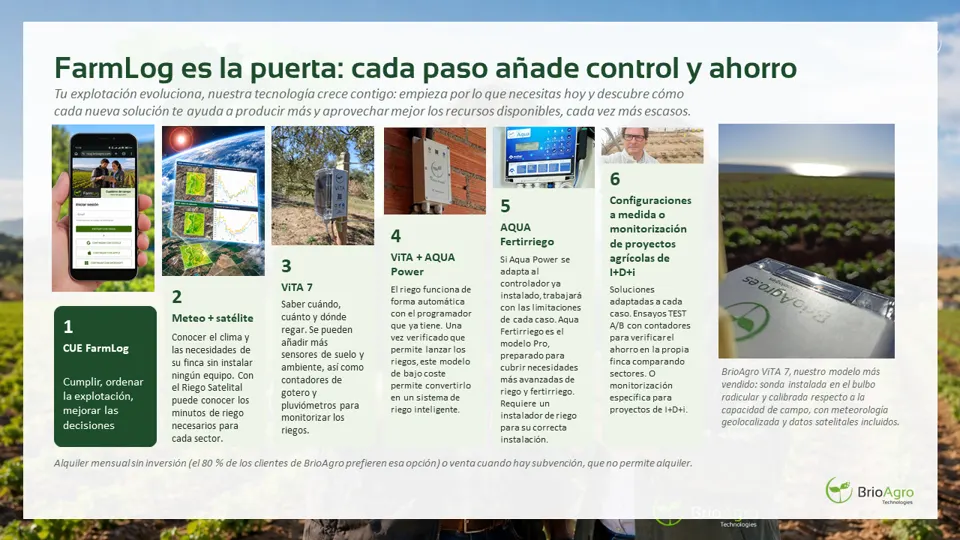
- CUE Farmlog: comply, organise the farm and improve decisions.
- Meteo + satellite: know the climate and the needs of the farm without installing any equipment. With Satellite Irrigation, you know the minutes of irrigation needed for each irrigation sector.
- ViTA 7: know when, how much and where to irrigate, with soil and ambient sensors, drip meters and rain gauges.
- ViTA + Aqua Power: irrigation works automatically with the irrigation controller the farm already has. This low-cost model allows it to be converted into a smart irrigation system.
- Aqua Fertirriego: the Pro model, prepared for more advanced irrigation and fertigation needs. It requires an irrigation installer for its correct installation.
- Bespoke configurations or monitoring of agricultural R&D projects: A/B TEST trials with meters to verify savings on the farm itself by comparing sectors.
You can rent each solution for a monthly fee, without investment (80% of BrioAgro's clients prefer this option), or buy it when there is a grant, which does not allow renting.
Greenhouses, trials and researchers: a single logbook for everyone
The choice of the Tecnova stand was no coincidence. BrioAgro wanted to present Farmlog to greenhouse crop agronomists and researchers from the Almeria technology centre, with whom it shares the European LIFE NextFUMIGREEN project. In this project, BrioAgro has been in charge of monitoring the greenhouses during the four years of trials.
Bustos acknowledged that Farmlog would have been a very useful tool from the start of that project. In addition to helping the farmer and their agronomist, the logbook documents everything that happens on the farm and organises the flow of information between those involved in it. In the new projects in which it participates, BrioAgro already uses it for this purpose: every action carried out in a trial is recorded and the information circulates between the farmer, the farm agronomist and the researchers without reconstructing anything retrospectively.
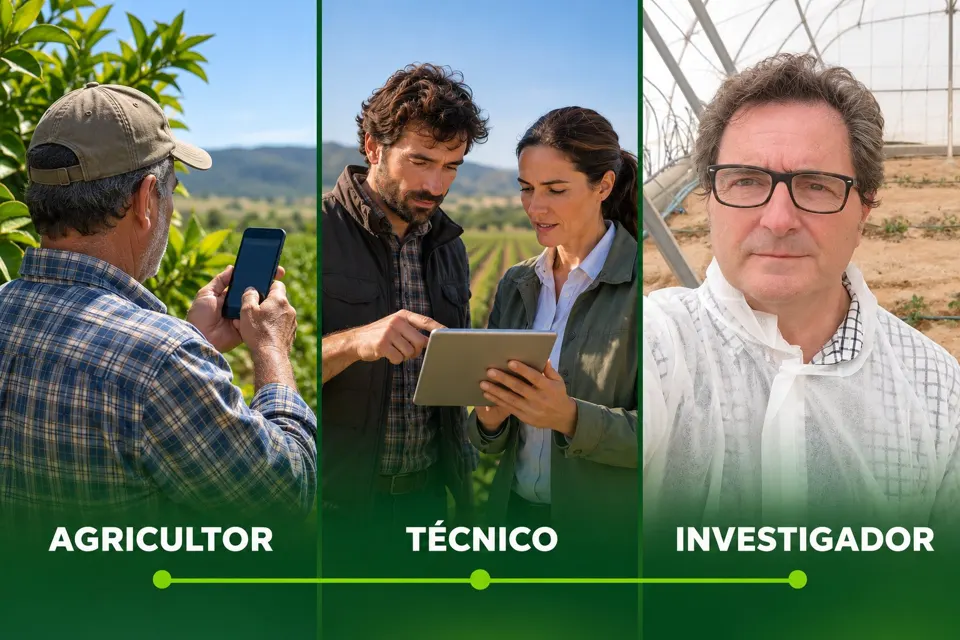
Each party contributes their part and reads the others' in the same logbook: the farmer records from the field, the agronomist validates and prescribes, and the researcher consults the complete history without asking anyone for data.
The argument applies to any agronomist who experiments, tests and documents to improve, whether or not they are part of a research project. A dose trial, a change of variety or a new irrigation strategy leave a mark in the logbook just as naturally as a mandatory treatment, and this mark allows campaigns to be compared and decisions to be made with data.
FAQs about the CUE and Farmlog
When is the digital farm logbook (CUE) mandatory for plant protection treatments?
Royal Decree 1039/2025, of 19 November, extends until 31 December 2026 the possibility of keeping a paper record of treatments with professional use plant protection products. From 1 January 2027, this record must be electronic.
What is Farmlog?
Farmlog is BrioAgro Tech's digital farm logbook (CUE). It gathers treatments, fertilisation, irrigation, harvests, inventory and documentation by farm and parcel. The farmer feeds it from WhatsApp and the agronomist validates the records from their panel.
How does a farmer record a treatment in Farmlog?
They communicate it via WhatsApp, with a message, an audio or a photo, just as they already do with their agronomist. Farmlog interprets it, creates the record associated with the farm and leaves it ready for the agronomist to validate. The original message is saved alongside the record.
How much does Farmlog cost for agronomists and advisers?
The agronomist platform is free. From a single dashboard, they manage all the farms they advise, with each one's season, its documentation and pending tasks.
Does Farmlog connect to the REA and SIEX?
Yes. Farmlog imports data from the REA and synchronises the logbook with SIEX in both directions. The agronomist prepares and reviews the communication to the Administration without duplicating entries. BrioAgro presents it as the first CUE operational in the 17 autonomous communities.
Can Farmlog be used in research trials?
Yes. Every action in a trial is recorded and the information circulates between the farmer, the farm agronomist and the researchers, without having to reconstruct anything later. It is also useful for a dosage trial, a variety change or a new irrigation strategy, inside or outside an R&D&I project.
Get started with Farmlog
- Agronomists and advisers: admin.farmlog.brioagro.com (free dashboard).
- Farmers: farmlog.brioagro.com.
- More information: Farmlog, BrioAgro's digital farm logbook and our article on how to turn the mandatory CUE into a useful tool.
- Contact: BrioAgro Technologies, phone +34 687 087 013.