 Every month, we analyse the evolution of the rainfed farms in the GEN4OLIVES project, located in Estepa. In addition to evaluating with technical criteria how the crop and the indicators we monitor are evolving, we have observed that the heavy rains in the second half of October have provided greater soil moisture, as we will detail, and that this water availability has lasted until the end of November.
However, the evolution of prices has influenced the extension of the season or the delay in the harvest.
Throughout 2023, the price of EVOO at origin remained relatively stable during the first months of the year, awaiting harvest expectations for the 2023-2024 season. At the beginning of October, the price did not drop below €8.50/kg, and in November, it seems that due to the flexibility shown by olive oil mills to close extra virgin oil contracts, the new prices are around €8.00/kg.
Ultimately, the price increase is due to the delay in the olive harvest because of its low yield, and because, due to the increase in kilos brought about by the October rains and those forecast for December, some rainfed producers will hold out as long as possible to increase those kilos of oil.
Sources from the Oleoestepa cooperative consulted by Agropopular (a radio programme in Spain that covers agricultural, climate and policy issues relevant to the rural community) have detailed that the recent price increase is due to the olive harvest being delayed as a result of its low yield. Source: "The price of olive oil goes on a roller coaster (in Spanish)"«
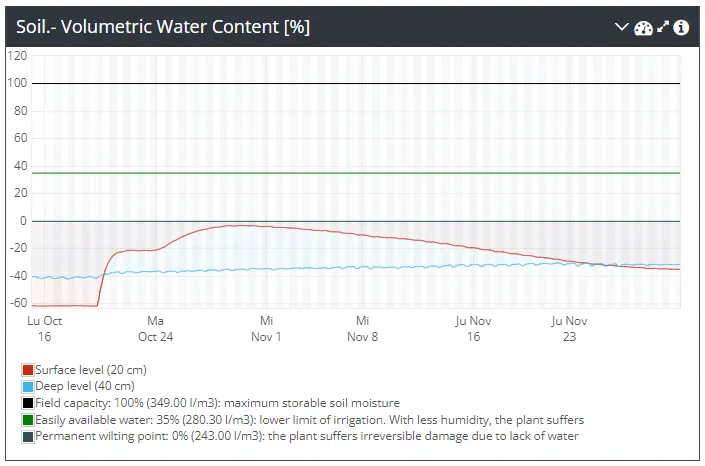 App screen in SpanishWe present the Soil Moisture Graphs for an olive farm belonging to the Manzanilla olive oil mill. The graphs show that moisture has remained low, clearly indicating water stress. Nevertheless, greater availability is recorded in November compared to early October, with over 62 litres per cubic metre on the days of greatest availability and 28 litres per cubic metre on those with the least.
Next, we present the evolution in October and November of the NDVI indicator in one of the monitored farms in Estepa.
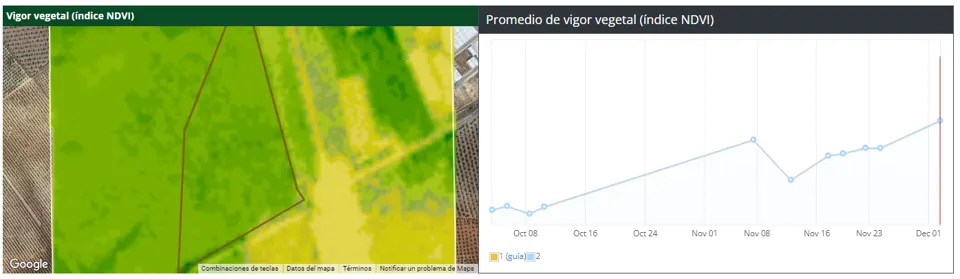
Monitoring the Normalised Difference Vegetation Index (NDVI) on the farms in Estepa, Seville, offers valuable insights into vegetation behaviour in the period from early October to late November. During this time, a notable growth in NDVI measurements is observed, indicating a significant change in vegetation health and density.
The 52% increase, from an initial value of 0.214 to 0.325, underlines the positive impact of the rains and subsequent clear days to obtain a good cloud-free photograph. This substantial growth in the NDVI not only highlights the positive response of the vegetation to weather conditions, but also suggests a general improvement in the productivity and quality of the plant environment.