On the occasion of the report ‘The countryside combats water stress with a rich innovative harvest‘, published on 21 July 2025 in the Economy section of the Spanish newspaper ABC,
We answered the following questions from the journalists, which we share here:
How did the AQUA system come about?
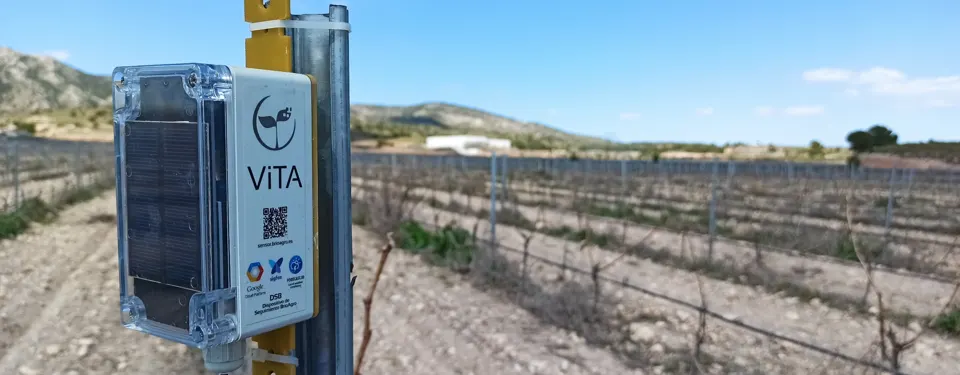
The AQUA system was born as an evolution of the BrioAgro ViTA sensors, designed to monitor the crop's vital signs. This system provides the necessary information to irrigate exactly when the plant needs it. This is BrioAgro's main differential contribution: starting from agronomic fundamentals and relying on innovative technology, it interprets the data to indicate the optimal irrigation time to the farmer.
Once it is determined when and how much to irrigate, AQUA comes into action: the actuator that executes the irrigation at the exact moment.
In short: first the ideal time to irrigate is identified and, then, with AQUA, the irrigation is carried out automatically.
What technology does BrioAgro use?
- Advanced sensors
It uses state-of-the-art analogue and SDI-12 sensors. The most relevant for irrigation are capacitive sensors, which measure the amount of water in litres per cubic metre of soil. - Internet of Things (IoT)
It uses robust dataloggers with multiple communications (2G/3G/4G, LoRa, etc.), powered by mini solar panels, which transmit data from the field in real time. - Cloud Computing
Since its foundation, BrioAgro has worked with the Google cloud, where data is stored and the analysis and interpretation algorithms are executed. - Algorithms and Artificial Intelligence
One of its main differentiators is the soil moisture calibration algorithm, which adapts to the type of crop and soil, continuously improving through artificial intelligence. - Geolocated meteorology
It provides real-time climate data and precise forecasts, adapted to each parcel and its specific agronomic needs. - Multispectral satellite imagery
It uses images from Sentinel (low cost) and Planet (high frequency and resolution) to detect irrigation deficiencies, nutritional or plant protection problems, and optimise irrigation in each irrigation sector of the farm.
How does it manage the data collected by the sensors?
The sensors collect data every few minutes. These are not stored locally, but are sent directly to the cloud, where they are processed and stored. The farmer accesses this already interpreted information, adapted to their crop and soil type, from their mobile or computer.
In which crops is it used most?
In any irrigated crop. We have experience in over 60 crop families: horticultural crops, woody crops, fruit trees, cereals, legumes, aromatic plants, tropical crops, seedbeds, industrial crops and animal feed crops… both outdoors and in the greenhouse.
We currently also monitor points in dryland cooperatives, to offer climate and soil data to farmers, even without irrigation.
What benefits does it bring to farmers?
Savings in water, fertilisers, plant protection products, labour dedicated to irrigation and energy. The energy savings are proportional: if water is reduced by 30%, the energy cost of pumping is also reduced by 30%.
In trials published by the SECH (Sociedad Española de Ciencias Hortícolas), BrioAgro achieved better results irrigating less than specialist agronomists and the FAO recommendations, also increasing production by applying irrigation at just the right time.
Does it involve a heavy investment?
No. You can start from €1,500, an investment that pays for itself in a few months. From there, it is possible to expand with new features, such as smart fertigation (the maximum functionality of the AQUA system) or more soil, climate or crop-specific sensors.
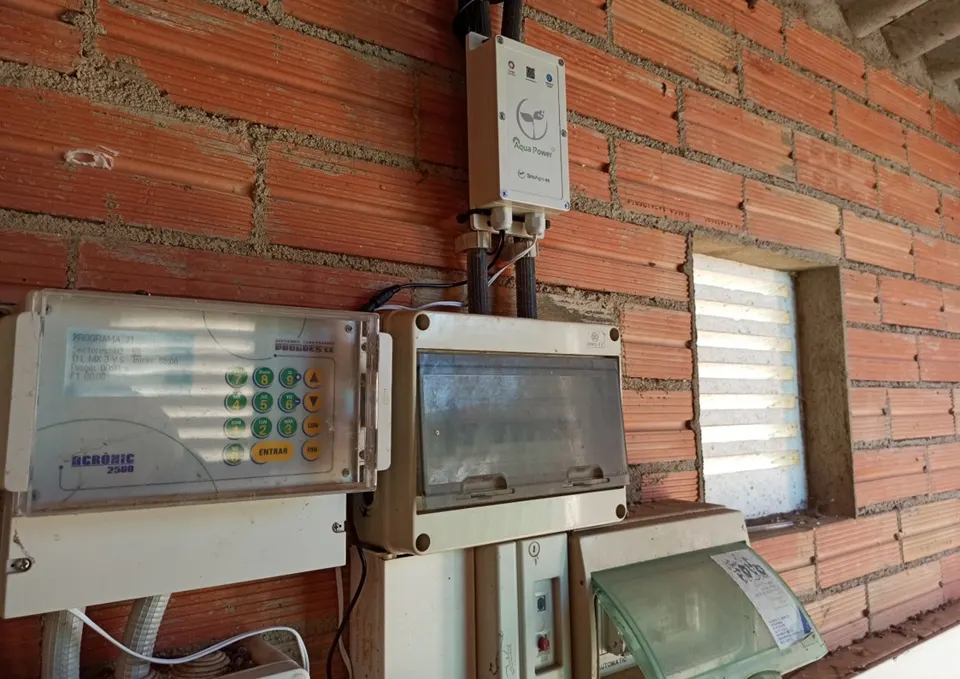
In addition, there is a “Lite” version, called Aqua Power, which integrates with the existing irrigation controller on the farm. You only have to add a small amount to the €1,500 to have a completely autonomous system. You can also try it with a monthly rental model at an even lower cost.
Thanks to the Kit Digital (Spanish government digitalisation grant programme), many small farmers are accessing the system at no initial cost, as this grant covers the €1,500 for agricultural holdings with fewer than three employees. This grant ends soon.
How important is technology for farmers to adapt to climate change?
It is key. Climate change constantly modifies usual patterns: heatwaves, extreme cold or intense rainfall require quick and well-founded decisions.
AQUA allows irrigation to be applied exactly when the plant needs it. Sometimes you have to irrigate more, on hot or windy days, and sometimes less, when moisture is conserved. This precision helps to optimise irrigation and protect crops against extreme conditions.