

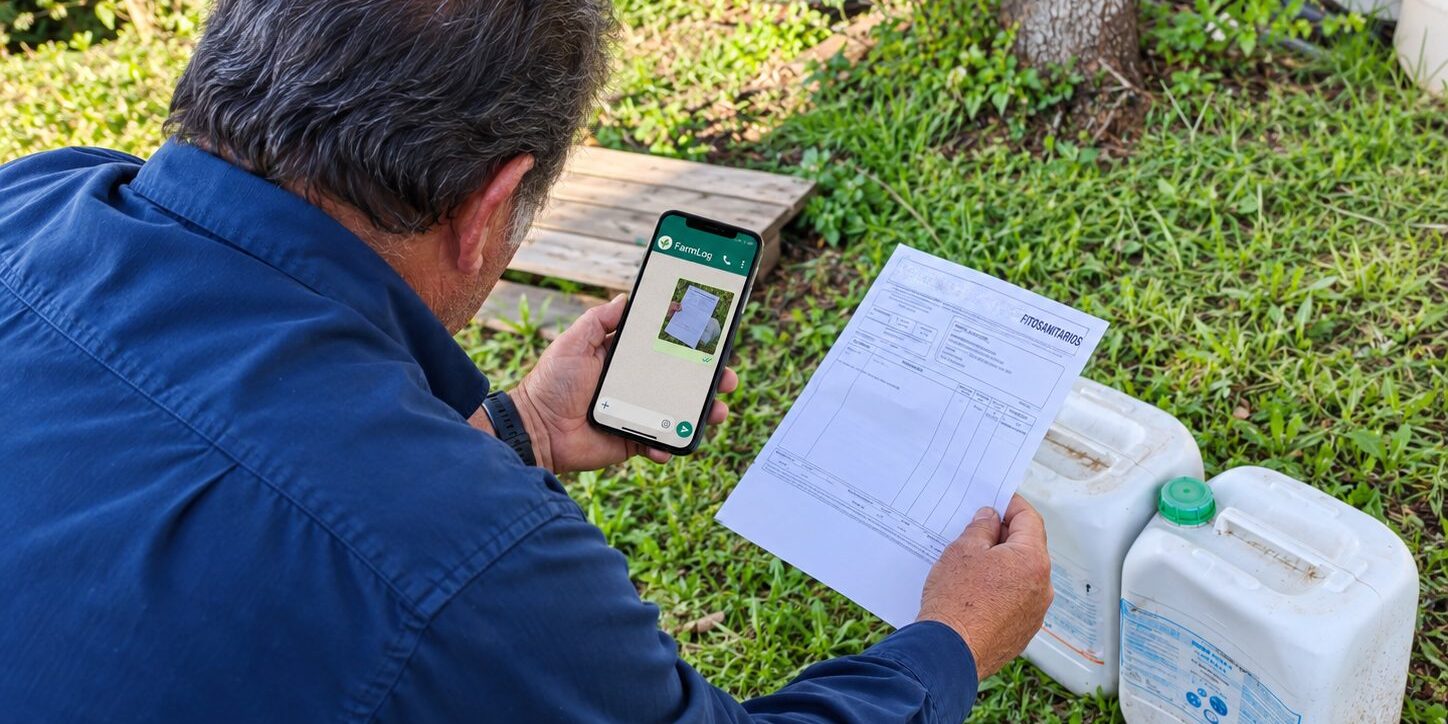
The mandatory CUE arrives on 1 January 2027: from that date, plant protection treatments in Spain must be recorded in the Digital Farm Notebook (Cuaderno Digital de Explotación, CUE). Many growers and technicians see it as yet another burden. BrioAgro Tech argues the opposite: with FarmLog, growers log their work via WhatsApp and advisors receive everything organised to comply… and to manage better.
Published in HortiDaily. This interview was published on Thursday 1 October 2026 in HortiDaily.es, written by Mauricio García, and the following day in its international English edition, HortiDaily.com, as “How to turn the CUE requirement into a useful tool for growers and advisors”. Here we reproduce it in expanded form, with a summary, a table of deadlines and frequently asked questions.
Key points in 30 seconds
- Key date: digital recording of plant protection treatments in the Digital Farm Notebook (CUE) becomes mandatory in Spain from 1 January 2027.
- Field notebook via WhatsApp: with FarmLog, growers report any operation with a message, a photo or a voice note, without learning a new app.
- Advisor dashboard: the technician reviews, completes and validates the records of all their farms from a single dashboard.
- Invoices and delivery notes: one photo is enough; FarmLog extracts products and quantities and stores the original document with the record.
- Connection with the authorities: it imports data from the REA (Spain’s General Register of Agricultural Holdings) and prepares submissions to SIEX according to each region’s integration. It is the first digital field notebook operational in all 17 Spanish autonomous communities.

From compliance obligation to management tool
With the digital notebook becoming mandatory for plant protection treatments on 1 January 2027, many growers and technicians see record-keeping as just another workload. At BrioAgro, they argue that the field notebook can instead be a management tool.
José Luis Bustos, the company’s director, sums it up:
“With FarmLog, the field notebook stops being a burden and becomes a management tool. Growers log any operation with a simple WhatsApp message, even by voice, and advisors have all the information on their farms up to date, ready to supervise, document and comply. Less time recording data, more time making use of it.”
José Luis Bustos, director of BrioAgro Tech
But he prefers to let someone who uses it every day tell the story. So he suggests talking to Enrique Jiménez, an agricultural engineer who has been handling his growers’ field notebooks for more than ten years and now works with FarmLog.
Interview with Enrique Jiménez, agricultural engineer and advisor
Why is the field notebook so often seen as a burden?
Because for years it has mainly been paperwork: writing down treatments, fertiliser applications, irrigation or harvests at the end of the day, when the grower is already tired, and often days later. With the move to digital, many fear it will mean even more work in front of a screen. And if the record only serves for compliance, it is logical that it is perceived as an obligation with no return.
What takes you the most time when keeping the notebooks of several farms?
Reconstructing what happened. One grower tells me about an operation by phone; another sends me a message; an invoice arrives days later. I need to know which plot each piece of data belongs to and whether anything is missing. When the information is linked to its farm, I can focus my review on completing and checking the records, with less searching through conversations and documents.
What changes with FarmLog?
The approach. FarmLog is a digital notebook, but not just another one: the idea is to move from recording data to making use of it. Plant protection treatments, fertilisation, irrigation, harvests, inventory and documentation are linked to each plot, with their traceability and history, and that information is shared with the advisor.
“The record stops being a file that is only opened during an inspection and becomes the basis for managing the farm.”
Enrique Jiménez, agricultural engineer
How does WhatsApp fit into this way of working?
Growers can report an operation with a message, a photo or a voice note from the field, without having to learn a new app. FarmLog turns that information into records that can be reviewed, and the original message is kept in case any questions arise.
For me, that automation is what makes the difference: I use a channel I already used with the grower, and I greatly reduce the need to chase them so that I can fill in the data myself afterwards. Review is still necessary: if the date, the plot or any detail of the operation is missing, it has to be completed.
Can you give an example of how it helps you day to day?
A grower carries out a treatment on a plot and sends FarmLog a WhatsApp voice note stating the date, the plot, the product and the quantity applied. That information makes it possible to prepare the record in the notebook. Within the maximum period of 30 days from the application, I review the record and, if any data is missing, we complete it together. When we plan the next treatment, we can check what was applied previously and when. In this way, a simple message from the field becomes useful information for advising the grower.
Who else is involved in the notebook, besides the grower?
We advisors take part: we review records, prescribe treatments and fertilisation, and monitor the farms. The technical teams of cooperatives, SATs (agricultural processing companies) or agricultural service companies can also be involved, with the appropriate permissions. FarmLog connects that work: the grower provides information, mainly via WhatsApp, and we organise and validate it from the technical dashboard.
The authorities are also involved: data is imported from the REA and the submission to SIEX is prepared, depending on the regional integration available. In this way, the CUE brings together information to advise, document operations and meet administrative requirements, and keeps the grower and their advisor coordinated.
What does it offer an advisor who works with several growers?
That is where it shows most. I can manage different farms from the same dashboard, review records and follow each grower’s season. Before a visit, I check the work carried out, the documentation and any pending issues, and focus the conversation on what needs attention.
In addition, when it is time to prepare the 2027 CAP applications, I will extract the records I need from the CUE and cross-check them with the REA data. Having kept that information organised and reviewed during the season already makes that work easier: it reduces last-minute queries, avoids asking for documents repeatedly and lets me devote more time to advising.
When does the record become useful information for management?
When I can go back to it to answer a specific question. For example, what fertilisation was applied before a harvest, when the last irrigation was recorded or which treatments are logged for a crop. Consulting the history gives context to the advice. Agronomic decisions still require technical judgement and knowledge of the farm and the crop.
How does FarmLog help with invoices and delivery notes?
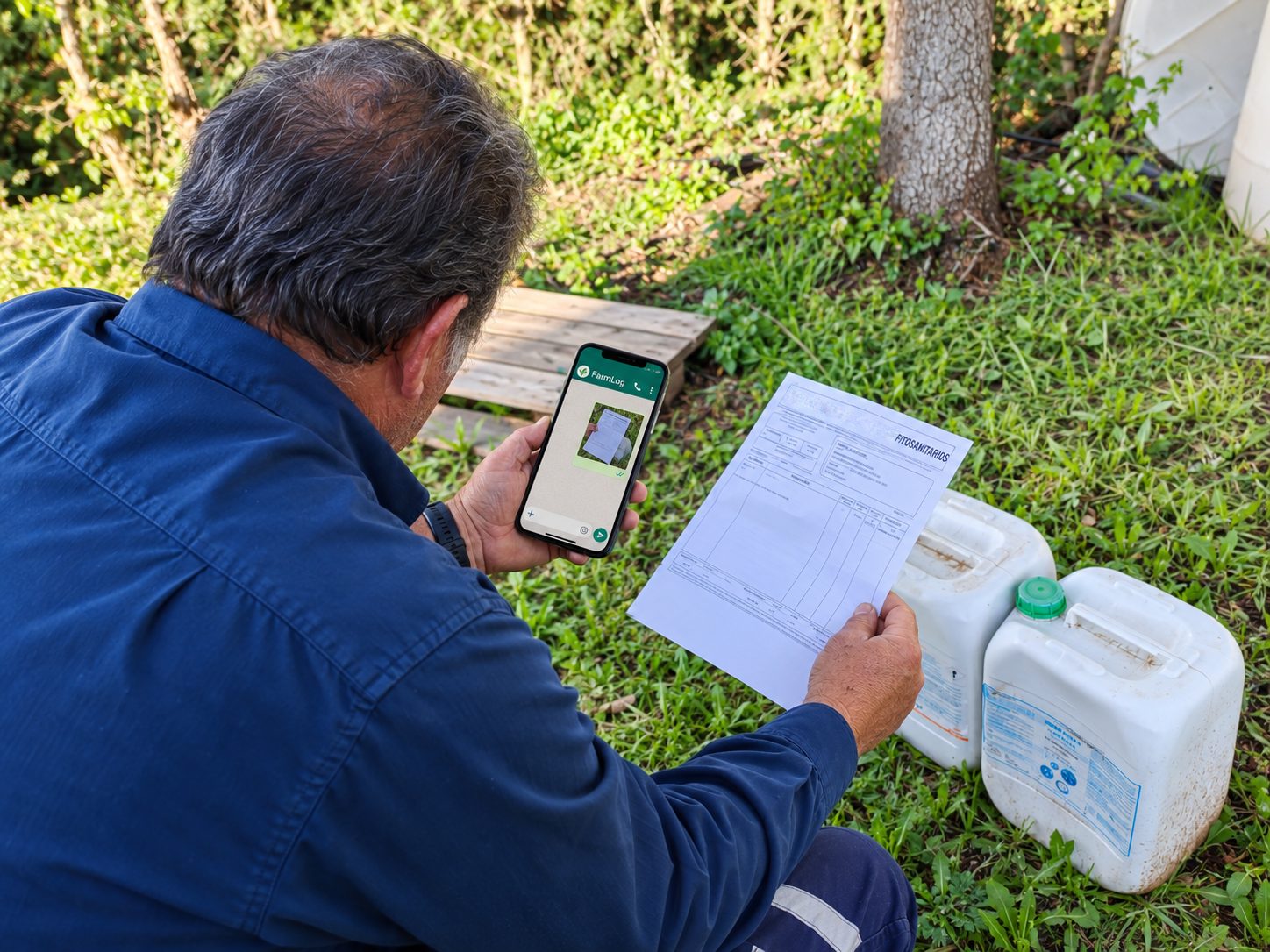
Growers can send a photo of the invoice or delivery note, and FarmLog automatically extracts data such as the products purchased and their quantities. This saves us from entering all the information by hand. I check that the data is correct and linked to the right farm, in order to review purchases and inventory. In addition, the original document is stored with the record, so we can consult it if any questions arise.
What the mandatory CUE in 2027 requires
What do the regulations require today?
Farms must keep up to date the records required of them by the regulations. For fertilisation, farms subject to the obligation must record each application within a maximum of one month. As for plant protection treatments, digital recording will be mandatory from 1 January 2027: each application must be recorded without undue delay and, if it is initially recorded on paper, it must be transferred to electronic format, as a general rule, within a maximum of 30 days of being carried out.
For other entries, the digital format remains voluntary unless there is a specific obligation. For the next CAP period, fertilisation and the remaining entries are also expected to be included. My advice is to record operations as they are carried out and to review the requirements and any applicable exceptions with your advisor.
| Type of record | Requirement | Deadline |
|---|---|---|
| Plant protection treatments | Digital recording mandatory from 1 January 2027 | Without undue delay; if recorded on paper, transfer to electronic format within a maximum of 30 days (general rule) |
| Fertilisation (farms subject to the obligation) | Record each application | Maximum one month |
| Other entries | Digital format voluntary unless a specific obligation applies | Expected to be included in the next CAP period |
More details in our article When does the CUE come into force for Spanish growers? (in Spanish).
And how does FarmLog help in preparing the digital notebook?
Keeping records up to date and storing their documentation makes it easier to prepare and review the Digital Farm Notebook, the CUE. Grower and advisor can work on the same information, each with their own access permissions. That organisation also helps to prepare the data that must be submitted to the authorities, in accordance with the applicable procedures.
What comes next and how to get started
How could the tool evolve?
Towards integration with irrigation and crop monitoring systems. BrioAgro also works with sensors and irrigation, and some of that data can reach the notebook without anyone having to write it down. It is a short-term line of work that points in the same direction.
“Less time recording and more time deciding and optimising resources.”
Enrique Jiménez, agricultural engineer
Does the grower have to change the way they work?
No, and that is key. FarmLog adapts to the way growers already communicate and record information, especially via WhatsApp. They do not need to learn how to use complex software: they can simply say what they have done, as they already do with their technician. In addition, growers who are more comfortable with digital tools can access their own dashboard to consult and manage their farm’s information directly.
How would you recommend a grower with little time gets started?
With a simple routine:
- Import the REA data or complete the farm’s basic information.
- Report the work done from the field every day.
- Review the records with their technician.
There is no need to change all habits at once. After a few weeks, they will be able to see how much time they spend keeping the notebook up to date, what information is missing and which questions they can answer by consulting the history. That way they can assess how useful it is in their daily work.
Access to FarmLog
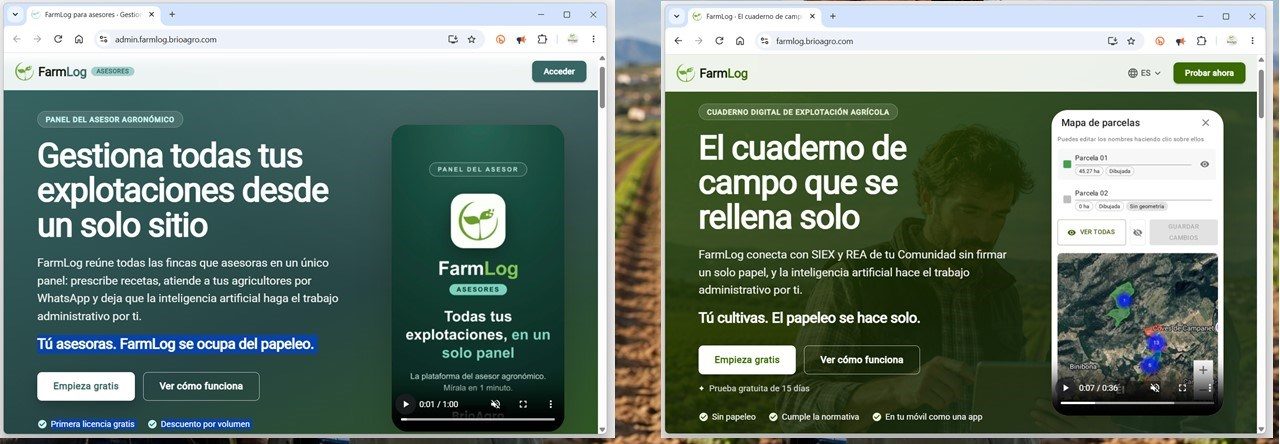
- Technicians and advisors: admin.farmlog.brioagro.com — manage all your farms from a single dashboard. First licence free and volume discounts.
- Growers: farmlog.brioagro.com — the field notebook that fills itself in, with a 15-day free trial.
Frequently asked questions about the CUE and FarmLog
From when is the CUE mandatory for plant protection treatments?
From 1 January 2027. Each application must be recorded without undue delay and, if it is first recorded on paper, it must be transferred to electronic format, as a general rule, within a maximum of 30 days.
Can the field notebook be filled in via WhatsApp?
Yes. With FarmLog, growers send a message, a photo or a voice note via WhatsApp; FarmLog turns it into notebook records that the advisor reviews and validates, and the original message is kept.
Is FarmLog suitable for advisors who manage several farms?
Yes. The advisor dashboard brings all farms together and lets you review records, prescribe treatments and fertilisation and follow each grower’s season. Cooperatives, SATs and agricultural service companies can also work on it, with their own permissions.
Does FarmLog connect with the REA and SIEX?
Yes. It imports REA data and prepares submissions to SIEX according to the integration available in each autonomous community. FarmLog is the first digital field notebook operational in all 17 Spanish autonomous communities.
Source: interview published in HortiDaily.es on 1 October 2026 and in HortiDaily.com on 2 October 2026. Photos: © BrioAgro.