These results are shown in an article published in Cell Reports Physical Science, the NYU Tandon team led by Dr. André Taylor, professor of chemical and biomolecular engineering and director of DC-MUSE (Decarbonizing Chemical Manufacturing Using Sustainable Electrification).
The current study builds on Professor Taylor's extensive work in renewable energy, with a recent emphasis on storing sustainably produced energy for use during off-peak hours.
RFD offers multiple benefits. These systems provide a scalable and flexible approach to energy storage, allowing the efficient utilisation of intermittent renewable energy sources such as solar and wind. RFD also promises a completely new solution to the global water crisis.
“By seamlessly integrating energy storage and desalination, our vision is to create a sustainable and efficient solution that not only meets the growing demand for freshwater but also promotes environmental conservation and renewable energy integration,” said Taylor.
RFD can reduce both the reliance on conventional power grids and foster the transition towards an eco-friendly and carbon-neutral water desalination process. Furthermore, the integration of redox flow batteries with desalination technologies improves system efficiency and reliability.
The inherent capacity of redox flow batteries to store surplus energy during periods of abundance and discharge it during peak demand aligns perfectly with the fluctuating energy requirements of desalination processes.
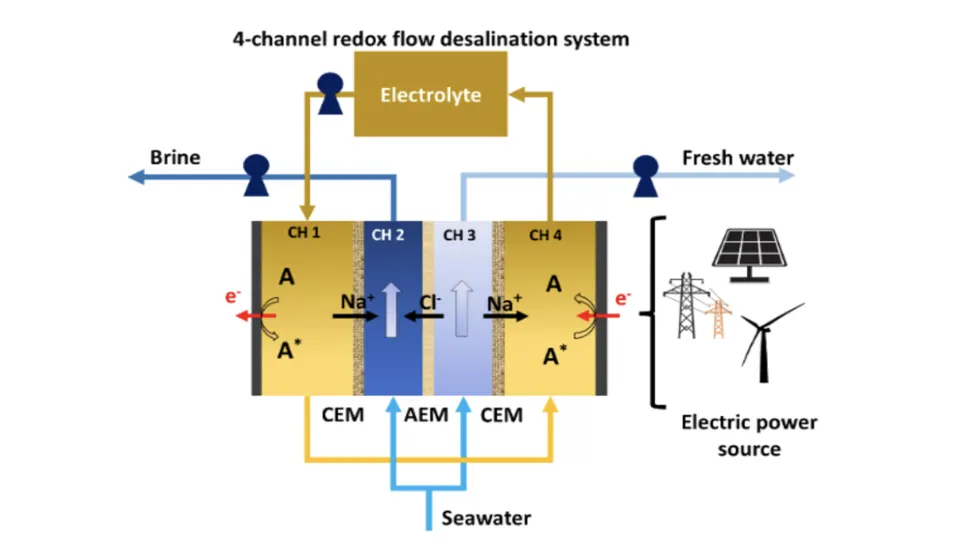
“The success of this project is attributed to the ingenuity and perseverance of Stephen Akwei Maclean, the first author of the article and a PhD candidate in chemical and biomolecular engineering at NYU Tandon,” said Taylor. “He demonstrated exceptional skill in designing the system architecture using the advanced 3D printing technology available at the NYU Maker Space.»
The complexities of the system involve splitting the incoming seawater into two streams: the salinisation stream (Image above, CH 2) and the desalination stream (Image above, CH 3). Two additional channels house the electrolyte and the redox molecule (Image above, A). These channels are effectively separated by a cation exchange membrane (CEM) or an anion exchange membrane (AEM).
In CH 4, electrons are supplied from the cathode to the redox molecule, extracting Na+ that diffuses from CH 3. The redox molecule and Na+ are then transported to CH 4, where electrons are supplied to the anode from the redox molecules, and Na+ is allowed to diffuse into CH 2. Under this overall potential, Cl- ions move from CH 3 through the AEM to CH 2, forming the concentrated brine stream. Consequently, CH 3 generates the freshwater stream.
“We can control the residence time of the incoming seawater to produce drinking water by operating the system in a single-pass or batch mode,” said Maclean.
In reverse operation, where brine and freshwater are mixed, the stored chemical energy can be converted into renewable electricity. In essence, RFD systems can function as a unique form of “battery”, capturing excess stored energy from solar and wind sources.
This stored energy can be released on demand, providing a versatile and sustainable complement to other electricity sources when needed. The dual functionality of the RFD system shows its potential not only in desalination but also as an innovative contributor to renewable energy solutions.
Although further research is required, the findings of the NYU Tandon team point to a promising path towards a more cost-effective RFD process, a critical breakthrough in the global quest for increased drinking water. As climate change and population growth intensify, more regions are battling water scarcity, underlining the importance of innovative and efficient desalination methods.
This research aligns perfectly with the mission of DC-MUSE (Decarbonizing Chemical Manufacturing Using Sustainable Electrification), a collaborative initiative established at NYU Tandon. DC-MUSE is committed to advancing research activities that decrease the environmental impact of chemical processes through the use of renewable energy. The current study builds on Professor Taylor's extensive body of work in renewable energy, with a recent emphasis on storing sustainably produced energy for use during off-peak hours.
In addition to Taylor and Maclean, the dedicated team of NYU Tandon researchers contributing to this study includes Syed Raza, Hang Wang, Chiamaka Igbomezie, Jamin Liu, Nathan Makowski, Yuanyuan Ma, Yaxin Shen and Jason A. Röhrl. Collaborating across borders, Guo-Ming Weng from Jiao Tong University in China also played a crucial role as a team member.
An exceptional milestone, this publication marks the 100th from Taylor’s Transformative Materials & Devices Lab. Originally established at Yale University in 2008 and subsequently moved to NYU Tandon in 2018, the laboratory focuses on the development of innovative materials and devices for energy conversion and storage, reflecting Taylor's enduring commitment to transformative research in the field.
Schematic of Professor Taylor's 4-channel redox flow desalination system, interpreted by Dall-E AI.
Source: NYU Tandon researchers discover an energy-efficient solution to the global water crisis