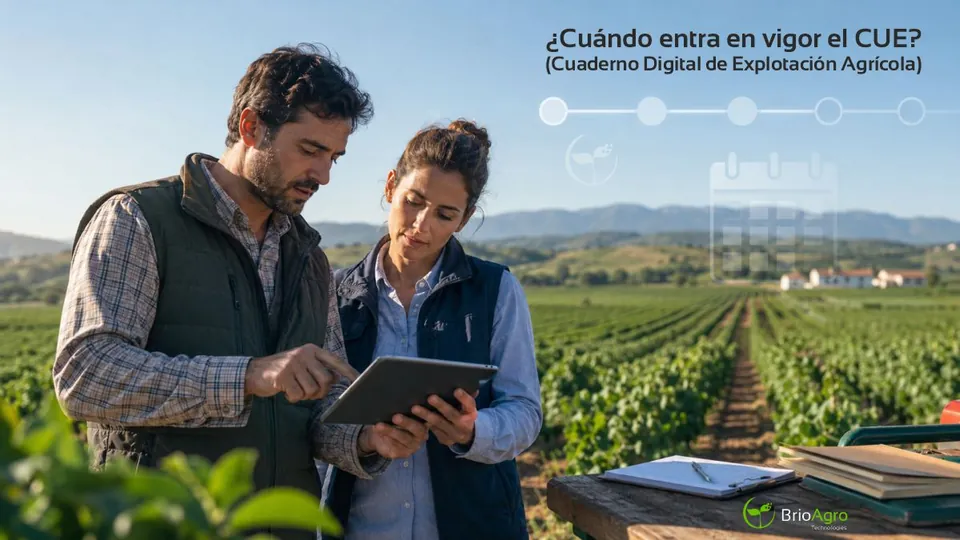
The digital farm logbook, known as CUE, does not come into force all at once for all Spanish farmers.
Its implementation is progressive and depends on the type of record: fertilisation, plant protection treatments, farm information, PAC, SIEX (Spain's farm information system) and other sectoral obligations.
The regulations have changed several times in recent years, so it is normal for there to be confusion.
The key idea is this: the complete digital CUE is generally voluntary, but some records do become mandatory on specific dates.
In this guide, we summarise the main dates for farmers, agronomists, agronomic advisers, cooperatives and agricultural service companies in Spain.
Quick summary: key dates for the CUE in Spain
| Date | What changes | What the farmer must do |
|---|---|---|
| 1 January 2026 | Mandatory record of certain information on fertilisation. | Record applications of nutrients, organic matter, dates, parcels, doses and product. This can be done on paper or digitally, depending on the case. |
| During 2026 | Adaptation period for the digital record of plant protection treatments. | Review how the farm logbook is being kept, organise parcels, crops, products, machinery, applicators and technical advice. |
| 1 January 2027 | Mandatory electronic record of plant protection treatments. | Digitally record plant protection treatments in the CUE or a system compatible with the relevant administration. |
| Next PAC framework | Possible progressive expansion of digital requirements. | Be prepared for new obligations related to PAC, SIEX, traceability and electronic data communication. |
So, is the CUE already mandatory?
Not entirely. The use of the digital farm logbook is generally voluntary, except when sectoral regulations require certain information to be recorded electronically.
This means that not all of the farm logbook automatically becomes digital for all farmers on a single date. The obligation is being implemented in stages, starting with specific aspects such as fertilisation and plant protection treatments.
What happens from 1 January 2026
From 1 January 2026, farmers must record certain information related to applications of nutrients or organic matter. That is, fertilisation data must be recorded, such as:
- Application date.
- Parcel or treated area.
- Type of fertiliser, nutrient or organic matter applied.
- Dose used.
- Information necessary to justify fertilisation management.
The key is that this obligation does not necessarily imply that everything must already be done in a digital format. In many cases, the record can continue to be kept on paper or in a digital tool, provided the required information is met.
What happens from 1 January 2027
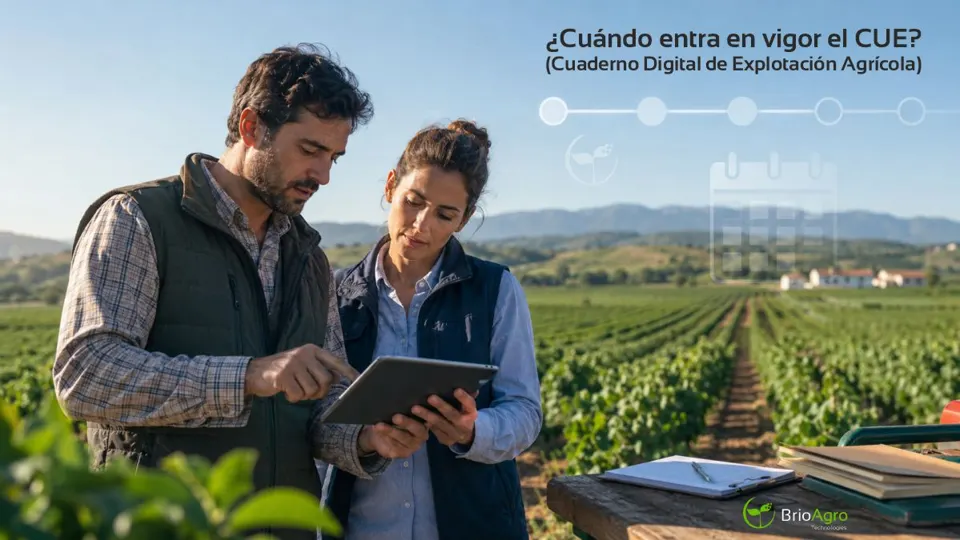
The most important date for the practical digitalisation of the logbook is 1 January 2027. From that moment on, plant protection treatments must be recorded electronically.
This affects farmers and professional users who apply plant protection products. From that date, paper records will no longer be sufficient for this part of the logbook.
Therefore, 2026 should be understood as a year of preparation: reviewing farm data, organising parcels, crops, products, machinery, applicators, advisers and documentation.
Which plant protection treatments will need to be recorded digitally
The digital record of plant protection treatments must clearly identify what has been applied, where, when, for what reason and by whom. Common data includes:
- Treatment date.
- Parcel, enclosure, crop or treated sector.
- Plant protection product used.
- Applied dose.
- Pest, disease, weed or reason for the treatment.
- Applicator or responsible person.
- Machinery or equipment used.
- Advice or agronomic prescription, where applicable.
What information the farmer must prepare
Although the complete digital obligation is not immediate for all sections, it is advisable to prepare the farm as soon as possible. These are the basic data that should be organised:
- Details of the holder and the farm.
- Parcels, SIGPAC (Spain's agricultural parcel identification system) enclosures, sectors and facilities.
- Crops, varieties and production cycles.
- Plant protection products and fertilisers used.
- Inventory and product purchases.
- Plant protection treatments.
- Fertilisation and fertilisation plans.
- Irrigation, harvests and destination of production.
- Documents, invoices, delivery notes, certificates and receipts.
Which farmers does it affect?
The obligation particularly affects professional farmers and farms that must keep records due to regulations on plant protection products, fertilisation, PAC subsidies, conditionality, traceability or communication with the agricultural administration.
Furthermore, although some small farms may keep part of their records on paper for longer, the administrative trend is clear: more electronic communication, more traceability and greater cross-referencing of data between the logbook, REA (Spanish register of farms), SIEX, SIGPAC and PAC.
Is the CUE the same as SIEX?
Not exactly. The CUE is the digital farm logbook where the farmer records their farm's activity. The SIEX is the agricultural and livestock farm information system, which allows agricultural information to be structured and communicated between administrations.
In practice, a good CUE should help the farmer to record information correctly and, when appropriate, facilitate its communication with SIEX depending on the autonomous community.
Practical calendar to get ready
| Timing | Practical recommendation |
|---|---|
| Now | Digitise the farm structure: parcels, crops, facilities, products and users. |
| During 2026 | Correctly record fertilisation and start working digitally with plant protection treatments. |
| Before 2027 | Choose a CUE tool compatible with the daily work of the farmer and the adviser. |
| From 2027 | Record plant protection treatments in electronic format. |
Why it is advisable to start before it becomes mandatory
Waiting until the last minute can lead to errors, incomplete data, duplications or adaptation problems. Starting earlier allows you to work with a margin and avoid the digital switch coinciding with heavy workload agricultural campaigns.
Moreover, the digital logbook should not be seen merely as an obligation. Used well, it helps to reduce paper, organise documents, improve traceability, facilitate work with the adviser and better prepare the information needed for inspections, audits or subsidies.
Farmlog: smart CUE for farmers and agronomists
Farmlog, BrioAgro's digital farm logbook, is designed to help farmers, agronomists and advisers prepare for this regulatory calendar.
From a single platform, Farmlog allows you to manage crops, plant protection treatments, fertilisation, inventory, documents, agronomic prescriptions from the adviser, communication with producers, REA import and data preparation for SIEX depending on the autonomous community.
Furthermore, it incorporates artificial intelligence to reduce administrative work: reading invoices and delivery notes, organising parcels, extracting data from documents and converting conversations into reviewable records.
Conclusion: key CUE dates
If you are a farmer in Spain, these are the three ideas you should remember:
- 2026: the obligation to record certain fertilisation information begins.
- 2027: plant protection treatments must be recorded electronically.
- The complete digital CUE: remains generally voluntary except for specific sectoral obligations, but the regulatory trend is moving towards increasingly digital agricultural management.
The practical recommendation is clear: do not wait until all obligations are definitive. Starting now with a digital CUE allows you to arrive prepared, with your data organised and with less administrative burden.
Discover Farmlog, BrioAgro's CUE.
Enquire via WhatsAppFAQs on the entry into force of the CUE
Is the digital CUE mandatory in 2026?
Not completely. In 2026 it is mandatory to record certain fertilisation information, but the complete digital CUE remains generally voluntary except for specific sectoral obligations.
When will it be mandatory to record plant protection products digitally?
From 1 January 2027, plant protection treatments must be recorded in electronic format.
Can I still use paper?
It depends on the type of record. For some obligations paper may still be valid, but plant protection treatments must switch to electronic format from 2027.
What is the difference between CUE, REA and SIEX?
The CUE is the logbook where agricultural activity is recorded. The REA is the Agricultural Holdings Register. SIEX is the state agricultural and livestock farm information system. Farmlog helps you work with these elements from a digital environment.
You can also consult Farmlog by autonomous community to learn about the CUE in your territory: Farmlog by autonomous communities.